
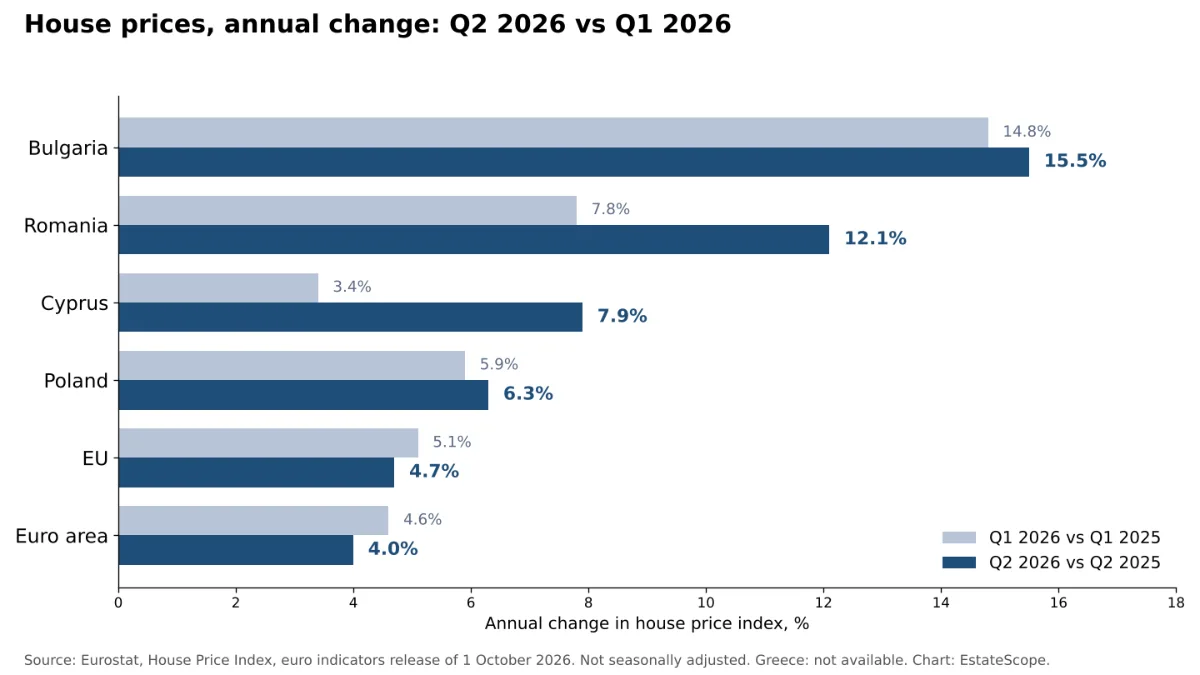
Romania's annual rate rose by 4.3 percentage points from the first quarter and Cyprus's by 4.5 points (EstateScope calculation). Poland was broadly stable, while the EU average eased. The release has no data for Greece.
What the index does not tell you
The index covers new and existing homes bought by households. It is adjusted neither for season nor for inflation, and it mixes all regions of a country. So a 4.4% quarterly rise should not be multiplied by four, and a national 12% says little about one building in Bucharest or Limassol. The index does not measure rents or yields, and it is not a forecast: neither "buy now" nor "wait for a correction" follows from it.
What to check as a buyer
In the faster markets, the main risk is overpaying on the strength of a national headline.
- Ask for completed sale prices of comparable homes in the same building or street over the last 12 months, not listing prices.
- Off-plan: read the clauses that let the developer change the price. In Cyprus, construction prices also rose in the second quarter.
- Investment: recalculate the yield at today's price with a documented rent. If prices rise faster than rents, the yield falls.
Limitations
Figures can be revised: Eurostat has already cut the euro area's Q1 rate from 4.7% to 4.6%. Georgia is not covered; Geostat publishes its own indicators. Q3 data are due on 11 January 2027.
Sources and limits

Eurostat — House prices up by 4.0% in the euro area (euro indicators, House Price Index Q2 2026) ↗
Official statistics · 2026-10-01
This is research, not investment, tax or legal advice. Definitions and observation dates remain attached to every claim.