Key figures
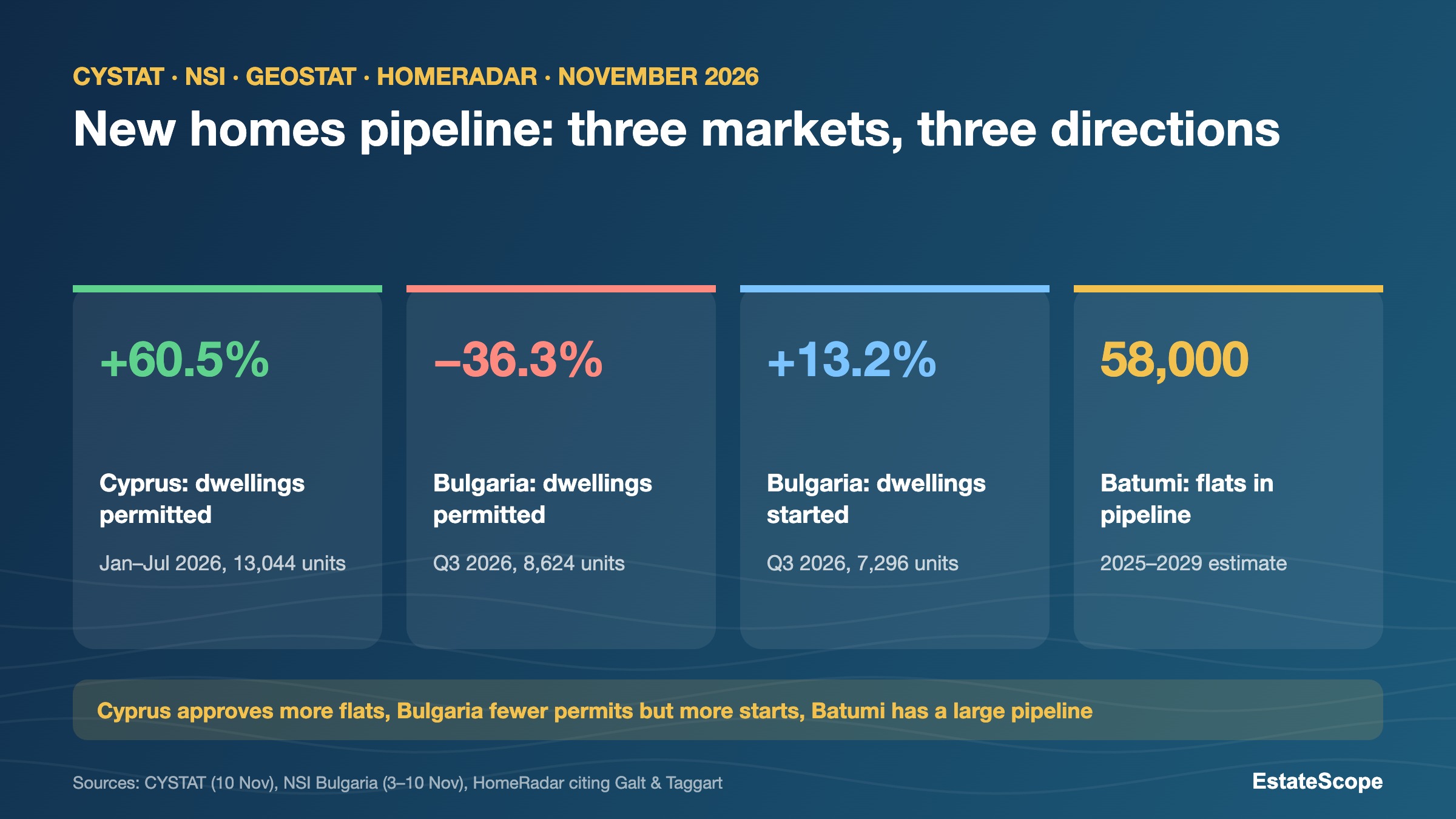
- Cyprus: building permits for 13,044 dwellings in January–July 2026, up 60.5% on a year earlier; flats in apartment blocks up 75.9%.
- Bulgaria: permits for 8,624 dwellings in Q3 2026, down 36.3% a year; construction started on 7,296 dwellings, up 13.2%; 5,325 dwellings completed.
- Bulgaria, September: construction output down 1.1% on the month, building construction up 4.1% on a year.
- Georgia: construction costs up 6.0% a year in September, but only 0.7% in residential construction.
- Batumi: up to 58,000 flats in the 2025–2029 construction pipeline, according to estimates cited by HomeRadar.
Cyprus: approvals are surging, but read them carefully
According to CYSTAT's release of 10 November, 5,173 building permits were issued in January–July 2026, 23.3% more than a year earlier. They provide for 13,044 dwellings, up from 8,128. Almost all of the increase comes from flats in apartment blocks (9,298, up 75.9%) and mixed residential/commercial blocks (902 against 180), while the number of single houses barely changed (2,039, up 1.0%). The residential floor area approved rose 56.6%, and the area of non-residential buildings fell 40.3%.
July alone was weaker: 772 permits, 3.0% fewer than in July 2025, though still for 1,944 dwellings worth €418.0 million in total.
CYSTAT points to an important technical factor: since 1 July 2024 permits are issued by the new Local Government Organisations through the Ippodamos system, which has also processed a large volume of older paper applications. By our assessment, part of the 2026 jump may therefore reflect cleared backlogs rather than new demand alone. For buyers, the direction is still clear: more apartment supply is being approved, mainly in multi-unit blocks, which over the next two to three years can widen choice and limit price growth for standard flats.
Bulgaria: fewer permits, but the building sites stay busy
Bulgaria's National Statistical Institute reported permits for 2,224 residential buildings with 8,624 dwellings in Q3 2026: the number of buildings was almost unchanged on a year (down 3.0%), but the dwellings in them fell 36.3%, so smaller projects are being approved. Most planned dwellings are in Sofia city (2,196), Plovdiv (1,303), Burgas (1,013) and Varna (960). At the same time construction started on 7,296 dwellings, 13.2% more than a year earlier.
Completions remain lower: 1,330 residential buildings with 5,325 dwellings were finished in Q3, with an average living area of 72.0 m². In September, construction output fell 1.1% on the month (seasonally adjusted) but building construction was 4.1% higher than a year earlier.
By our reading, Bulgaria's pipeline is still full for the next one to two years, because starts exceed completions, but the sharp drop in dwellings permitted suggests a thinner flow of new projects later. Buyers looking at Sofia, Plovdiv or the coast may find more choice in buildings now under construction than in new launches.
Batumi: a large pipeline, stable building costs for flats
In Georgia, the construction cost index rose 6.0% a year in September 2026, driven by transport, fuel and electricity (+25.9%) and wages (+5.4%), but residential construction costs rose only 0.7%. By our reading, building costs are not currently a major driver of flat prices.
The bigger factor is supply. HomeRadar's outlook cites Galt & Taggart's estimate of about 58,000 flats in Batumi's 2025–2029 construction pipeline, around 46,300 of them intended for investment use. Demand has not disappeared: Galt & Taggart counted 17,478 registered apartment transactions in 2025 (+15%), while Colliers reported 1,614 deals in September 2026, 10.4% fewer than a year earlier, at a weighted average new-build price of $1,408 per m² (+5.2%).
What it means for buyers
- Cyprus: more approved flats should mean more choice from 2027–2028; check whether a project's permit is new or a processed older application, and compare handover dates.
- Bulgaria: the current wave of construction keeps choice high in 2026–2027; fewer new permits may tighten supply later, especially for larger family flats.
- Batumi: with tens of thousands of similar rental flats due by 2029–2030, the unit's location, layout and management matter more than the city-wide trend; compare completed and under-construction options before paying a premium.
Frequently asked questions
Does a permit mean a home will be built? No. A permit allows construction; projects can be delayed, changed or cancelled. Starts and completions are the better measure of actual supply.
Why do Cyprus permits grow so fast? Demand for apartment blocks is part of it, but CYSTAT notes that the new Ippodamos system has also processed many older applications since July 2024.
Are Batumi prices falling because of the pipeline? Not according to the latest data cited by HomeRadar: Colliers' average new-build price rose 5.2% a year in September 2026, even as the number of deals fell.
Sources and limits

CYSTAT — Building Permits, July 2026 ↗
Official statistics · 2026-11-10

NSI Bulgaria — Building permits issued and construction started, Q3 2026 ↗
Official statistics · 2026-11-03
NSI Bulgaria — Short-term statistics of residential buildings, Q3 2026 ↗
Official statistics · 2026-11-06
NSI Bulgaria — Construction production indices, September 2026 ↗
Official statistics · 2026-11-10

Geostat — Construction Cost Index in Georgia, September 2026 ↗
Official statistics · 2026-11-06

HomeRadar — Batumi in 2027–2030: new supply and rental outlook (EN) ↗
Company research · 2026-11-02
HomeRadar — Batumi 2027–2030 outlook (RU) ↗
Company research · 2026-11-02
This is research, not investment, tax or legal advice. Definitions and observation dates remain attached to every claim.