Key figures
- House prices in Bulgaria rose 15.5% in the year to Q2 2026 and 4.5% in the quarter alone (National Statistical Institute, NSI).
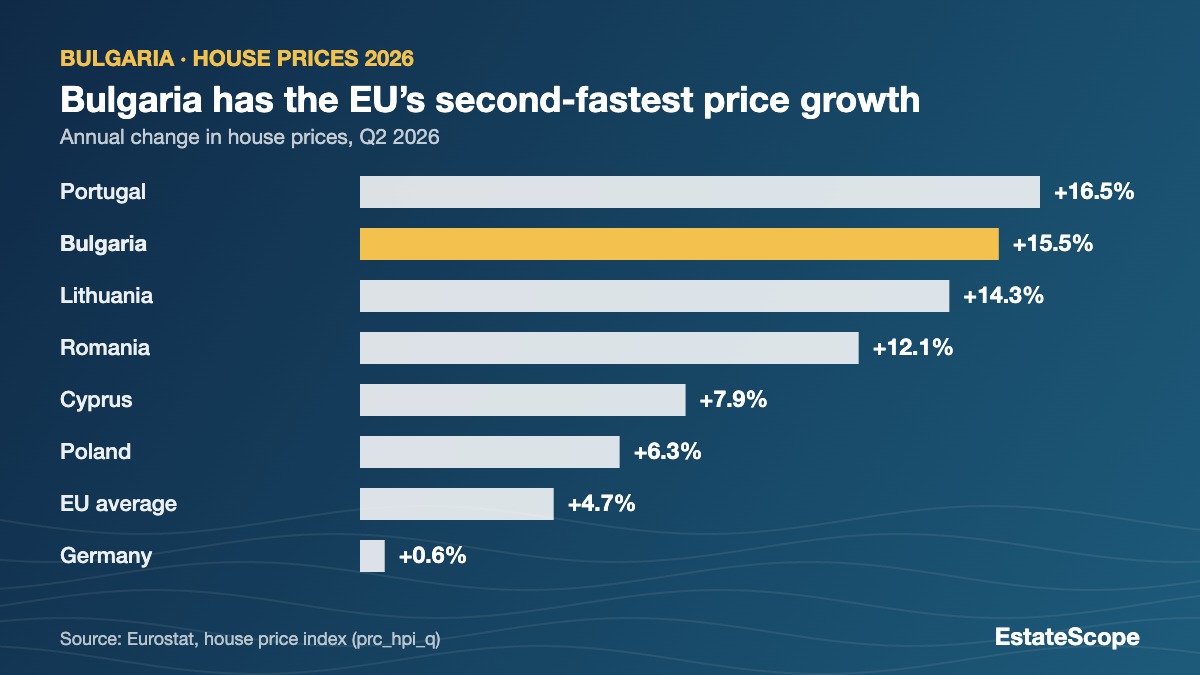
- That is the second-fastest rise in the European Union after Portugal (16.5%) and more than three times the EU average of 4.7% (Eurostat).
- Since the end of 2019 Bulgarian house prices have more than doubled (+113%), against +37% for the EU as a whole (our calculation from the Eurostat index).
- Existing homes are rising faster than new ones: +17.6% against +12.3% a year.
- Housing loans reached €19.65 billion in September 2026, up 24.8% in a year, at an average rate of 2.41% on new loans (Bulgarian National Bank).
Annual growth has stayed between 12.6% and 18.3% in every quarter since the start of 2024. This review brings together the official price, credit and construction data to show where prices are rising fastest, what is driving them and what to watch next.
Bulgaria among the fastest-rising markets in the EU
According to Eurostat's house price index, only Portugal recorded faster annual growth than Bulgaria in Q2 2026. Romania (12.1%), Cyprus (7.9%) and Poland (6.3%) were all well behind, while prices in Germany were almost flat (+0.6%) and fell in France.
Two and a half years of double-digit growth
| Quarter | Bulgaria, all dwellings | New dwellings | Existing dwellings | EU average |
|---|---|---|---|---|
| Q1 2024 | +16.0% | +19.3% | +14.1% | +1.5% |
| Q2 2024 | +15.1% | +15.6% | +14.8% | +3.0% |
| Q3 2024 | +16.5% | +16.6% | +16.5% | +4.0% |
| Q4 2024 | +18.3% | +19.7% | +17.4% | +4.9% |
| Q1 2025 | +15.1% | +13.4% | +16.2% | +5.8% |
| Q2 2025 | +15.5% | +14.9% | +16.0% | +5.4% |
| Q3 2025 | +15.4% | +11.0% | +18.2% | +5.5% |
| Q4 2025 | +12.6% | +9.0% | +15.0% | +5.4% |
| Q1 2026 | +14.8% | +12.5% | +16.3% | +5.1% |
| Q2 2026 | +15.5% | +12.3% | +17.6% | +4.7% |
Annual change in the house price index. Source: Eurostat (prc_hpi_q), NSI data.
The brief slowdown at the end of 2025 did not last: growth picked up again in the first half of 2026. Compounded, the index shows prices up about 54% since mid-2023 and about 95% since mid-2021. Q2 2026 is the latest quarter available; the NSI has not yet published Q3.
Cities: Plovdiv leads, Burgas pauses
The NSI's Q2 2026 release shows how unevenly the large cities moved in a single quarter:
| City | Change in Q2 2026 vs Q1 2026 |
|---|---|
| Plovdiv | +5.8% |
| Stara Zagora | +2.9% |
| Varna | +2.8% |
| Sofia | +2.4% |
| Burgas | −1.5% |
| Bulgaria | +4.5% |
One quarter does not make a trend, and city indices are more volatile than the national one. Still, the gap matters for buyers: seaside Burgas, where new homes are on average the smallest, fell while inland Plovdiv rose fastest. City choice now matters more than the national headline.
Why existing homes are rising faster
Since the start of 2025, prices of existing dwellings have grown faster than those of new ones in every quarter, and the gap widened to more than five percentage points in Q2 2026. One possible explanation, which the statistics themselves do not test, is that buyers using cheap mortgages are turning to completed flats they can move into or let now, rather than waiting for off-plan projects. The gap also means that new-build prices are no longer pulling the market up on their own.
What is driving prices: cheap and fast-growing credit
According to the Bulgarian National Bank, housing loans reached €19,645.6 million at the end of September 2026, 24.8% more than a year earlier. New mortgage lending in September was €643.6 million, and the average interest rate on new housing loans was 2.41% (APRC 2.76%). Housing loans now account for about 59% of all household borrowing.
Bulgaria joined the euro area on 1 January 2026, so prices and loans are now in euro and new borrowers no longer face lev–euro currency risk. Credit growth has eased only slightly, from 25.7% in July to 24.8% in September, so financing is still supporting demand.
Supply: fewer new flats in the permit pipeline
In Q3 2026 municipalities issued permits for 8,624 dwellings, 36.3% fewer than a year earlier, while construction started on 7,296 dwellings (+13.2%) and 5,325 dwellings were completed (NSI). The fall in permits came mainly from fewer large apartment blocks. In the short term, projects already under way keep supply flowing; further out, fewer permits mean a narrower choice of new projects, especially in Sofia and on the coast.
What comes next: the signals to watch
Official data do not provide a forecast, and we do not make one. The balance of signals is mixed:
- Supporting prices: mortgage rates below 2.5%, lending still growing by about a quarter a year, and a shrinking permit pipeline.
- Pointing to a slowdown: credit growth easing slightly, the dip at the end of 2025, falling prices in Burgas in Q2 and a price level that has more than doubled since 2019.
The next checkpoints are the NSI's Q3 2026 house price release, monthly BNB credit data and any move in euro-area interest rates, which now feed directly into Bulgarian mortgage pricing.
What it means for buyers
Compare cities, not the national average. In one quarter, the difference between Plovdiv and Burgas was more than seven percentage points.
Check the total cost of credit. The headline rate is low, but compare the APRC, the fixed-rate period and what happens to the payment if euro-area rates rise.
Do not assume growth will continue at 15%. Test whether a purchase still makes sense if prices flatten for a few years.
If you are comparing Bulgaria with other markets, see our review of Q2 2026 house prices in Romania, Cyprus, Bulgaria and Poland.
Frequently asked questions
Are house prices in Bulgaria still rising in 2026?
Yes. In Q2 2026 prices were 15.5% higher than a year earlier and 4.5% higher than in Q1, according to the NSI.
Which Bulgarian city has the fastest price growth?
In Q2 2026, Plovdiv (+5.8% on the quarter), followed by Stara Zagora, Varna and Sofia. Prices in Burgas fell by 1.5%.
How much have Bulgarian house prices risen since 2019?
By about 113% from the end of 2019 to Q2 2026, according to our calculation from the Eurostat index, compared with about 37% for the EU.
How much does a mortgage cost in Bulgaria?
The average interest rate on new housing loans was 2.41% in September 2026, with an APRC of 2.76%, according to the Bulgarian National Bank.
Sources and limits

National Statistical Institute of Bulgaria — House Price Statistics, Q2 2026 ↗
Official statistics · 2026-09-23

Eurostat — House price index (prc_hpi_q) ↗
Official statistics · 2026-10-03

Bulgarian National Bank — Monetary statistics, September 2026 ↗
Official statistics · 2026-10-27
National Statistical Institute of Bulgaria — Building permits and construction started, Q3 2026 ↗
Official statistics · 2026-11-03
This is research, not investment, tax or legal advice. Definitions and observation dates remain attached to every claim.